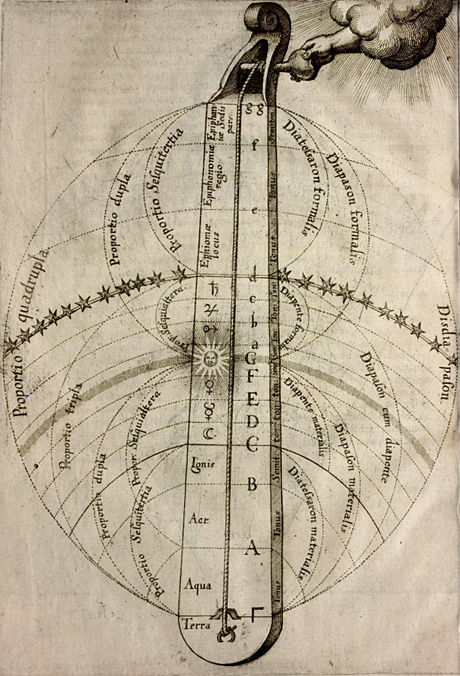
 Robert Fludd’s Monochord, figuring the scales of creation as cosmic harmony
There is a rich history in The Music of the Spheres and it comes down to us through the seasons of the mind. The stamp left on our soul by our love of music is so immensely profound it can hardly be overestimated.
In this pair of lectures I want to discuss the various forms that harmony has taken in the life of man and what we can learn by it’s shape and motion. I will argue that music is essential to life and that our love of music is our greatest treasure. I want to distinguish between what I will call mythic harmony and scientific harmony. In the first of these two lectures I want to focus on Mythic harmony how the idea of Universal Harmony has come to down to us and what it meant to those who believed in it.
The Music of the Spheres presents the image of man’s life being bound by the musical operations of his environment. The life lived becomes the bow to the string drawn and adjacent tones alone compose the chords of truth and beauty. In these lectures we will discuss the search for universal language and our relationship with music both as artists and as celebrants.
Of the earliest echoes from the memories of man we find the story of Orpheus and Eurydice recounted by the poets Virgil and Ovid
Orpheus was a renowned musician son of Apollo. Eurydice was his lover and earthly muse. In the myth Eurydice suffers an early death which turns Orpheus to greif. Drunk on his own suffering he becomes the first mortal to travel to the underworld. Orpheus who was granted the musical gifts of his father petitions Hades and Persophene to let his wife return with him to the land of the living:
As Virgil puts it in his Georgics:
He even entered the jaws of Taenarus the high gates
of Dis and the grove dim with dark fear
and came to the spirits and their dread king and hearts
that do not know how to soften at human prayer
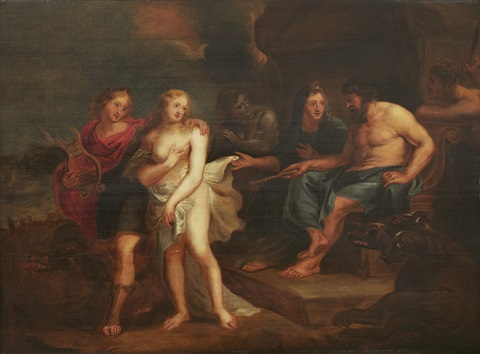 Orpheus and Eurydice in the Underworld, unknown painter(s) from the Antwerp School
But Orpheus is armed with his lyre and his love and so we see the story continued by Ovid in his Metamorphoses
And with his words the music
made the pale phantoms weep: Ixion’s wheel
Was still Tityus' vulture left the liver
Tantalus tried no more to reach for the water
And Belus' daughters rested from their urns
And Sisyphus climbed on his rock to listen.
That was the first time ever in all the world
The furies wept.
Here we see music as a motive force and these hearts not moved by prayer are moved by this song of love loaned and borrowed. What are we to make here of the collection of cautionary brothers those who bear the burden of the mark of man granted temporary forgiveness through Orpheus' song? The ending of the myth is no happy tale; we see Orpheus struck by the forgetfulness of man losing his last chance to embrace his lover’s skin. He turns back to attend his lover, though forbade by Hades. Orpheus’s tragic gaze is often discussed by philosophers throughout the ages.
So Orpheus is said to have lost love twice and in the passing of time the Muses take his tongue as a medallion. His head is placed on a silver platter long after his death the Thracian Bard continues to sing the song of love twice lost.
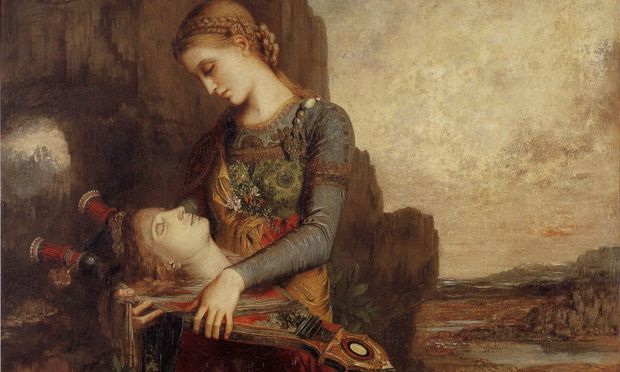 Thracian Girl Carrying the Head of Orpheus on His Lyre by Gustave Moreau
We can learn much from the morals of this story as applied to our lives, for it bears fruit for thousands of years to come and many of our greatest thinkers have turned it over in their minds. I think many more still will turn it over to come. But what does this show us about the relationship between music and the gods? How was it that Orpheus’ melody turned their hand and granted Eurydice a second life?
We can look further back in greek mythology though we have to travel forward to the musings of the roman Emperor Julian the apostate, who converted from his Christian faith to the last dying cry of greek paganism.
Here in his Oration to the Sovereign Sun:
“The divine race of intellectual gods above the heavens are replenished from the Sun with boniform powers to those whose authority the whole choir of the stars submits and whose nod generation which he governs by his providence attentively obeys. For the planets indeed dancing round him as their king harmoniously revolve in a circle with definite intervals about his orb producing certain stable energies and advancing backwards and forwards … to which we may add as manifest to every one that the light of the moon is augmented or diminished according to her distance from the sun.”
Here we see plainly Julian’s view of a cosmic harmony noting the harmonic intervals the planets take in their relative revolutions around the sun. And so the moon is said to be occultly defined by the light of sun.
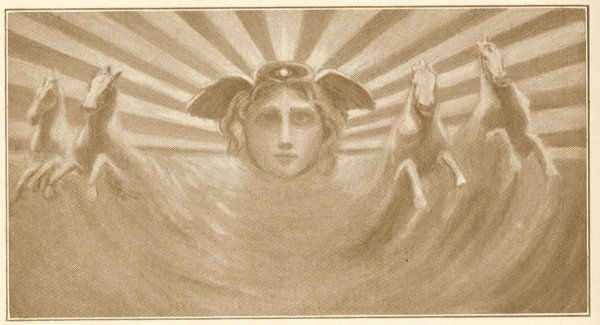 Apollo and His Chariot, unknown artist
In the Greek legends Apollo, the God of the Sun, had a twin sister Artemis who ruled over the Moon. These twin gods were the masculine and feminine incarnations of harmony in motion. Artemis was the Goddess of the hunt, of the Moon, of childbearing, and ritual magic. Apollo was the God of medicine, the Sun, of music, and divination. But both are characterized by two key qualities: Action at a distance and the reckoning of opposites. It was said that Apollo and Artemis were far-darting: Apollo roughly translating as ‘he who is always shooting’ and Artemis as ‘she who acts from afar’. Both are said to have been the causes of sudden death; Apollo in men and Artemis in women. If you fell over struck dead you’d know who caused it.
Thomas Taylor the great English Neoplatonist in his introduction to the Emperor’s Orations lays bare the occult meaning of Apollo:
There is a great multitude of medicinal prophetic harmonic and arrow-darting angels daemons and heroes suspended from Apollo who distribute in a partial manner the uniform powers of the God. … The Telestic or mystic art endeavors through sympathy to conjoin these ultimate participants with the gods. … For the medicinal power which takes away the multiform nature of disease imparts uniform health since health is symmetry.”
Just as notes in a symphony suspend partially from the totality of the work so a votary to Apollo partially imparts the totality of harmonic symmetry. Here we can see the best of the Pythagorean and Platonic systems in resonance. They enacted harmony through rituals of song and dance; through the act of analogy or sympathy they had second births and created something where before it was not.
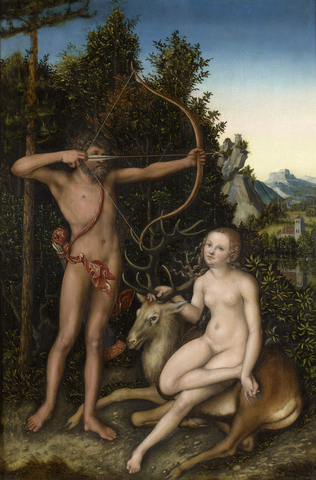 Apollo and Diana by Lucas Cranach
To understand this sympathetic link between the emissaries of Apollo we should turn to the Orphic tradition as interpreted by the Pythagorean school.
The Orphites were the ritualistic followers of the Orpheus from our stories. Most likely inspired by the Chaldean Oracles the Orphic tradition introduced a symbolic emanationism on top of the Greek legendry. To these religious few our story of Orpheus and Eurydice was full of occult substance and received many and varied expansions. They believed Orpheus lived several years after his return from the underworld and taught disciples the things he saw. What survives of these teachings are the Hymns of Orpheus recorded by Onomacritus which taught of a precession of supervening deities suspended from one another in a chain of necessity.
Pythagoras was said to have received the teachings of the thracian bard and modified many of these teachings to his own work. Simplicius in his Commentaries on Aristotle writes:
“The Pythagoreans believed a harmonic sound was produced from the motion of the celestial bodies and they scientifically collected this from the analogy of their intervals.”
Analogy is fundamental to Pythagorean thought as we can see in the life of the Pythagorean: Aristotle records in his Metaphysics:
Eurytus determined which number belongs to which thing—e.g. this number to man and this to horse—by using pebbles to copy the shape of natural objects like those who arrange numbers in the form of geometrical figures the triangle and the square.
This form of point-wise visualization of figures through their numbers has captured the imagination of mathematicians throughout history from Ford’s tangential circles to Pascal’s geometric triangle but it’s origin lies in Pythagorean thought. A figurate number can be thought of as a collection of dots as a triangle can be made of 1 dot of 3 dots of 6 or 10. There is a simple formula for triangle numbers you start with n=1 and add n=n+1 each step. 1+2+3+4….
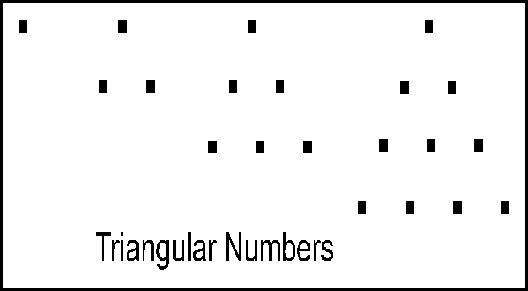 Progressions of the tetraktys, each phase is what is known as a “triangular number”
Eurytus turns this on it’s head and says that things can be analogized on account of their sharing the same number of composite dots! A number like 64 then can be both a square and a cube on account of it having both a square and a cube root. This style of thinking was evidently passed to him by the Pythagorean school for Pythagoras saw patterns of number in the motions of the heavens the same on the motion of a string. Pythagoras was said to be the father of music theory on account of his recognition of the rational intervals described by succession of the first few integers.
More than sound however the numbers described an alchemical cosmology as Strabo preserves the writings of the Pythagorean Ocellus Lucanis here quoting from his On the Nature of the Universe:
“Every nature which has a progression possesses three boundaries and two intervals. The three boundaries therefore are beginning middle and end but the intervals are the progression from beginning to middle and from middle to end. … Thus animals require a conjunction with air for the purpose of respiration but light for the purpose of sight other senses with something else. … The sun and moon the planets and the zodiac have likewise a harmony with the world as being parts of its common arrangement. … Fire which imparts heat is itself hot and honey which is sweet to the taste is itself from itself sweet. … That which is to other things the cause of their harmony is itself from itself co-harmonized.”
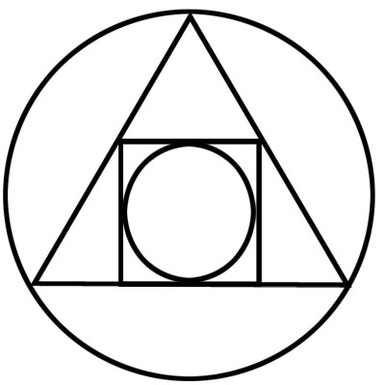 Geometric proof “squaring the circle”
How robust was the Pythagorean system that it saw the same in the transmutation of the elements as the scale of the octave as the tasting of honey? That each could be considered in terms of a conjunction between boundaries and interval of things in themselves and the transferrence of relation between them - Quoting the work again:
“Fire indeed when it is congregated into one thing generates air but air generates water and water earth. From earth also there is the same circuit of mutation as far as to fire from whence it began to be changed. And fruits and most plants that derive their origin from a root receive the beginning of their generation from seeds. When however they bear fruit and arrive at a maturity they are resolved into seed nature producing a complete circulation from the same to the same.”
Aristotle and later Proclus go on to expand this system but first we see it move through Plato’s account of Pythagorean Cosmology in his Timaeus, on the harmonic creation of the soul:
“He bent them into a circular form connecting them with themselves … he made the one the outer and the other the inner circle. Now the motion of the outer circle he called the motion of the same and the motion of the inner circle the motion of difference”
It is clear that we see the echoes of Pythagorean thought here in Plato’s - the circles of sameness and difference of unity and duality. The ratios on the circle describe intervals the same as are described by the motions of the heavens revolving around their axis according to their quality and kind. Here we see Plato borrow from the Pythagorean tradition to give wings to his flight of the soul. But it was Pythagoras who heard the music of the spheres and recorded it in his tetraktys.
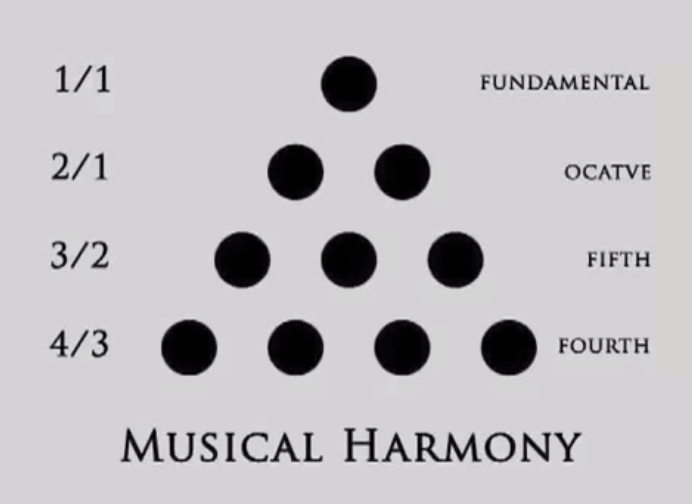 Music theory in the tetraktys
In the next lecture we will examine the mark of this theory of universal harmony on man’s life first through late antiquity then the renaissance and up to the modern age. We will see how it moves from astronomical theory to musical theory to number theory and astrophysics and socio-political theory explaining a rich and complex structure in terms of harmonic wave analysis. The greek legends and the Pythagorean tradition paint with broad strokes which creates a nutritive space for our mind to pull out harmonic tones.
The pythagorean style of life offered simply what we struggle so complexly for today the theurgic state of embodied meaning. We want our lives to mean something but we are afraid to define what that meaning might be. Still there is no shortage of ways to cut the octave and we will see how tunings will come in and out of focus like players in an orchestra harmonizing one another with the thing in themselves.
And thus much on mythic harmony.